
Categories
Florida, Investment, Investment Property, Multifamily properties, property taxes, Rental propertiesBy Thomas Bichi — Keller Williams Capital Realty, Coral Gables. FL Lic. SL3261222. 11 years on the ground in Miami-Dade.
Florida is about to put one of the largest property tax changes in state history on the November ballot — and Miami homeowners, buyers, and investors need to understand exactly what it says, and what it doesn't.
On June 2, 2026, the Florida Legislature passed HJR 1F , officially titled "Save Our Homes from Excessive Property Taxes," during a special session. The vote was 75-26 in the House, 30-9 in the Senate. It now goes to the November 3, 2026 general election — where it needs 60% voter approval to become law.
Nothing changes today. If it passes, the first changes hit January 1, 2027. Here's what's actually in it.
The Exact Ballot Language
Florida voters will see this on their November ballot:
SAVE OUR HOMES FROM EXCESSIVE PROPERTY TAXES
Homestead; property tax exemptions; assessment limitations; government spending. Expands homestead property tax exemptions for non-school levies; reduces annual cap on non-homestead property assessment increases from 10% to 5%; restricts county and municipal property tax revenue to specified governmental purposes; prohibits local governments from reducing public safety funding below prior year levels; and establishes a process for further eliminating homestead property taxes over time. Effective January 1, 2027, or January 1 after approval.
Worth noting: this language is already the subject of a lawsuit filed June 11, 2026 by former Florida mayors who argue it reads like a campaign slogan rather than a neutral description. A court may require the Attorney General to rewrite the summary before November — but the amendment stays on the ballot either way.
What the Amendment Actually Does
The homestead exemption jumps — but only for non-school taxes
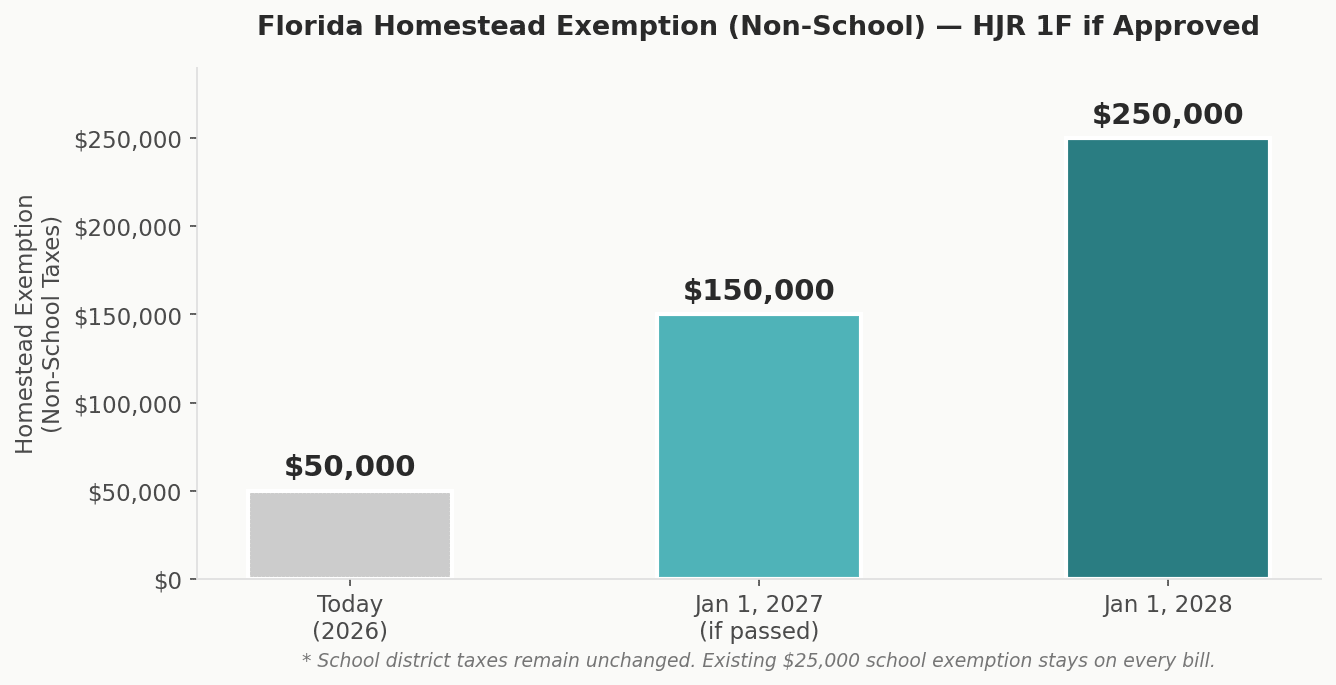
Today, Florida homestead properties are exempt from the first $50,000 of assessed value for all property taxes. If this amendment passes:
- January 1, 2027: Non-school exemption rises to $150,000
- January 1, 2028: Rises again to $250,000
- 2029 and beyond: Adjusts annually with the Consumer Price Index
Critical detail: School district taxes are explicitly excluded. The existing $25,000 exemption still applies to school levies. On a typical Miami-Dade tax bill, school taxes are roughly 30–40% of the total — so the savings are real, but not as dramatic as some headlines suggest.
I've had clients call me this week asking if Florida is eliminating property taxes. It is not — at least not yet. This amendment creates a pathway toward elimination through future legislative action, but nothing is eliminated now.
The non-homestead assessment cap drops from 10% to 5%
This one matters directly for investors and landlords. Currently, the assessed value of rental properties, vacation homes, small multifamily, and commercial real estate can increase up to 10% per year. This amendment cuts that cap to 5% starting January 1, 2027 .
For a duplex in Coral Gables or a triplex in Coconut Grove that has been assessed aggressively over the last three years, this limits future tax exposure. It's a quieter win than the homestead headline, but meaningful for anyone holding investment property in Miami-Dade. You can read my full breakdown of buying small multifamily in Miami for more on how taxes factor into those deals.
New residents wait five years for the full exemption
Anyone who establishes Florida residency after December 31, 2026 starts with a reduced exemption and must maintain Florida residency for up to five years before qualifying for the full amount.
If you're an out-of-state buyer — from New York, California, or internationally — this is worth planning around. Establish residency before December 31, 2026 and the clock doesn't apply. I work with a lot of international and out-of-state buyers through investmiami-livemiami.com ; this is now a real part of the conversation.
Restrictions on how local governments spend property tax revenue
Counties and municipalities would be limited to spending property tax revenue on public safety, education, infrastructure, flood control, debt obligations, employee retirement, and general government operations. This sounds reasonable until you look at the revenue math below.
Schools Are Protected. Police and Fire Have a Floor. But the Math Is Still Hard.

The version that passed is different from what DeSantis originally proposed. His initial plan would have applied the expanded exemption to all property taxes — including schools. Lawmakers removed that during the special session, protecting school district funding entirely.
On public safety: the amendment prohibits counties and municipalities from reducing law enforcement funding below their 2024 or 2025 levels . Fire and EMS are listed as priority uses of remaining revenue.
Schools are explicitly protected. Police and fire have a legal funding floor. But with billions less in total revenue, local governments face difficult math — and the cuts will land somewhere.
Legislative staff estimated the amendment reduces local government revenue by $4.6 billion in FY2027-28 , growing to $8.4 billion in FY2028-29 . Several economists put the 5-year figure near $12 billion annually by 2031.
Miami-Dade has some of the highest assessed values in the state — which means it's one of the largest revenue losers. Parks, libraries, code enforcement, permitting, road maintenance — these absorb cuts when police, fire, and schools are protected. Some homeowner savings may come back as higher non-property-tax fees or special assessments. That's not an argument against the amendment; it's a real consideration that doesn't show up in the headline number.
Thinking about buying or investing in Miami before November? I help clients navigate this market every week. Schedule a free consultation , or follow  @investmiami_livemiami on Instagram for regular market updates and deal intel.
What the Savings Actually Look Like in Miami
One important correction circulating online: DeSantis's original announcement proposed $250,000 in 2027, rising to $500,000 later. Lawmakers scaled that back during the special session. What is on the ballot is $150,000 in 2027 and $250,000 in 2028.
Here's what the savings look like at the full $250,000 exemption (2028 level), county by county:
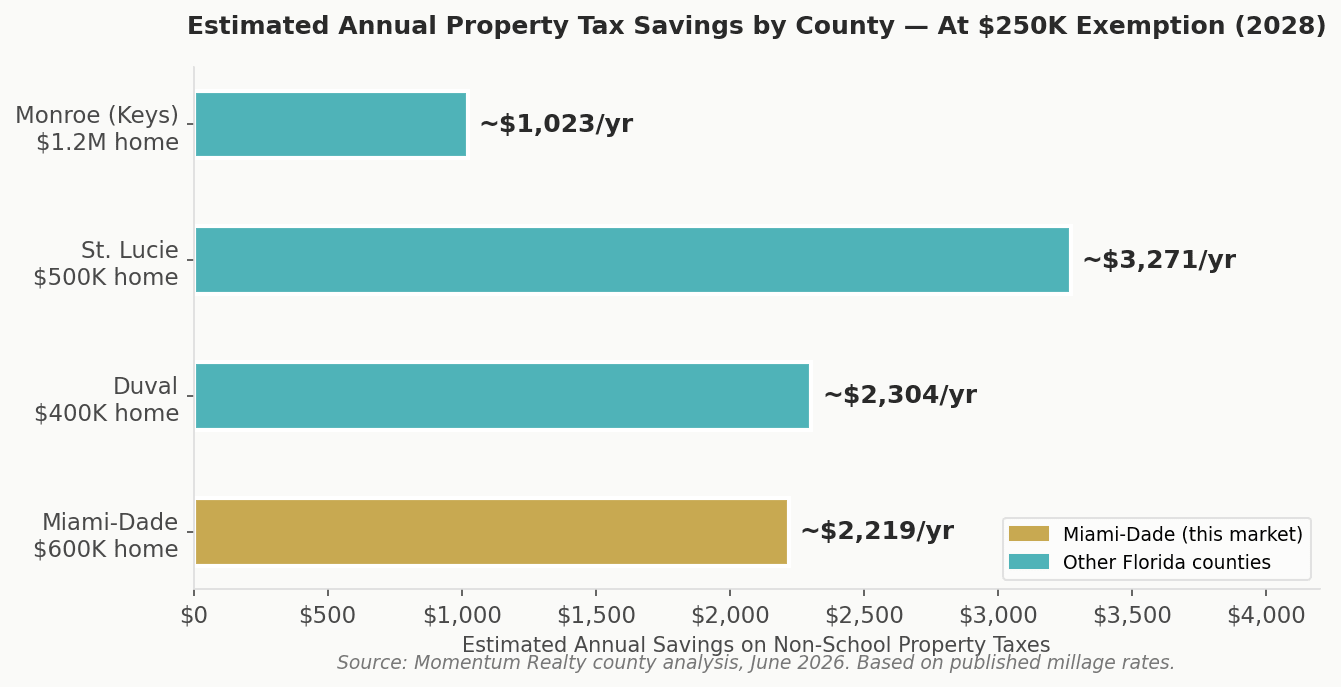
Miami-Dade Estimated Annual Savings
$2,219
On a $600K homesteaded home at the 2028 exemption level (~$185/month)
Real money — but not the $400–500/month some viral posts are claiming. Miami-Dade's millage rate is lower than most of Florida, so high-value homes here save less per dollar of assessed value than homes in mid-priced high-rate counties. And remember: school taxes, unchanged, make up 30–40% of your bill.
What I tell buyers I'm working with right now: don't base your purchase decision on this amendment passing. It needs 60% in November — that's a high bar. Plan with current tax law, treat any savings as a bonus.
That said, the five-year residency waiting period for anyone establishing Florida residency after December 31, 2026 is a genuine reason to accelerate your timeline. Follow @investmiami_livemiami — I post updates as they develop.
What This Means If You Own Investment Property in Miami
The 5% non-homestead assessment cap is the most direct benefit for landlords and investors. It limits how fast your tax basis grows on rental properties, vacation condos, and small multifamily in Miami .
The caveat: if local governments face revenue pressure, fee hikes and special assessments on non-homestead property are a plausible response. I've seen this in Miami-Dade before — county budget pressure tends to surface in places that don't get the same political attention as property tax rates.
For clients running DSCR loan underwriting on rental property, I'd keep expense assumptions at current tax rates for now and revisit after November. If you want to run numbers on a specific deal, reach out through my investment advisory page .
What Happens Next: Full Timeline
- Summer 2026: Lawsuit over ballot language plays out. May require revised wording — doesn't remove the amendment.
- November 3, 2026: Florida voters decide. Needs 60% to pass.
- January 1, 2027: If approved — $150,000 non-school homestead exemption begins. Non-homestead cap drops to 5%.
- January 1, 2028: Exemption rises to $250,000.
- 2029+: CPI adjustments begin. Legislature must establish a process for local governments to pursue full elimination by referendum.
I'll cover every development as we approach November. For updates, visit investmiami-livemiami.com .
Frequently Asked Questions
What is the Florida property tax amendment on the 2026 ballot?
It's HJR 1F, officially titled "Save Our Homes from Excessive Property Taxes." The Florida Legislature passed it on June 2, 2026. It goes to voters November 3, 2026, and needs 60% approval to take effect. It expands the homestead exemption for non-school taxes from $50,000 to $150,000 in 2027 and $250,000 in 2028, and cuts the annual assessment cap on investment properties from 10% to 5%.
Will Florida eliminate property taxes in 2026?
No. This amendment expands the homestead exemption and creates a legislative process for future elimination — but that requires additional action and local referendums. School taxes are unchanged. Nothing happens until voters approve it in November and effective dates arrive in 2027.
How much will the Florida homestead exemption increase?
If approved in November 2026, the non-school homestead exemption rises from $50,000 to $150,000 on January 1, 2027, and to $250,000 on January 1, 2028. CPI adjustments begin in 2029. The school tax exemption ($25,000) is unchanged.
How does this affect Miami homeowners specifically?
A $600,000 homesteaded home in Miami-Dade would save approximately $2,219 per year at the 2028 exemption level. Miami-Dade is also one of the state's largest revenue losers under this amendment, meaning local fee and service adjustments are more likely here than in rural counties.
Does the amendment affect rental and investment properties?
The homestead exemption expansion doesn't apply to rentals or investment properties. However, the amendment cuts the annual assessment cap on non-homestead properties — rentals, vacation homes, commercial — from 10% to 5% beginning January 1, 2027.
What happens to school and public safety funding if it passes?
School district taxes are explicitly excluded from the expanded exemption — school funding is protected. Law enforcement has a statutory floor; counties cannot reduce it below 2024 or 2025 levels. Fire and EMS are listed as priority uses. The budget pressure falls on other services — parks, libraries, code enforcement — which are not similarly protected.
About Thomas Bichi
Thomas Bichi is a Miami real estate advisor with Keller Williams Capital Realty in Coral Gables, with 11 years helping homebuyers, sellers, and investors across Miami-Dade County. Florida License SL3261222.
For Miami market updates, new listings, and behind-the-scenes deal insights, follow Thomas on Instagram @investmiami_livemiami , visit investmiami-livemiami.com , or reach out directly to discuss your goals.